 OnSite
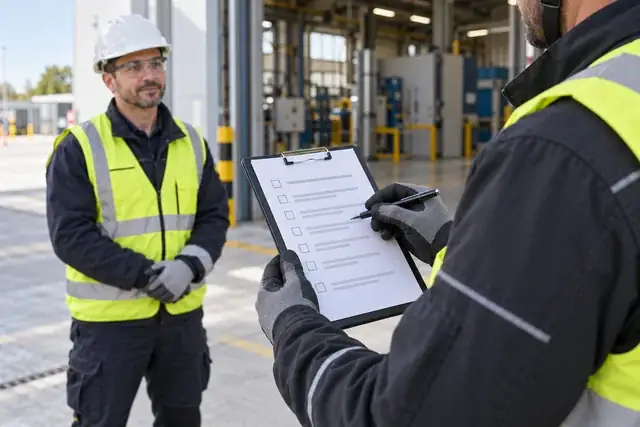
US onboarding checklist
Select the trade and record the documents and site questions your team has reviewed.
Explore →
SOURCING FORCE ONSITE · BUY MADE EASY INC.
Business licensing, worker training, employer qualification and site authorization answer different questions. Match the evidence to the actual electrical, lifting, asbestos or access task before the work begins.

Author of the French books « Fondamentaux de l’Acheteur Professionnel » and « Maîtriser le Processus Achats »
01 · YOUR PROJECT
Identify what each crew member will do, which equipment they will use and which employer assigns or supervises the task. The business license, course record and site induction may all be relevant, but none should be treated as a universal permission for unrelated operations. The actual work determines the evidence needed.
Federal OSHA or an applicable State Plan sets relevant employer requirements, while states and municipalities may regulate trade or contractor licensing. Record the jurisdiction and task before selecting a checklist. A document from a prior site may be useful history without satisfying the new project’s requirements.
OSHA Outreach 10-hour and 30-hour cards document course completion. OSHA states that the program is not a certification and does not fulfill the employer’s training duties under specific standards. A project can impose additional conditions, but it should not advertise an Outreach card as qualification for every electrical, rigging or confined-space task.
02 · YOUR PROJECT
State the electrical operation, installation and exposure conditions. The responsible employer assesses workers for their assigned duties, and the site identifies who controls isolation and return to service. Qualifications for work on or near exposed energized parts must be considered under the applicable electrical safety requirements, separately from generic attendance records.
Business and individual licensing can also apply. In Texas, non-exempt electrical work must be performed by appropriately licensed individuals through a licensed electrical contractor. Other jurisdictions have their own requirements. The plant and project participants review the actual exemption or licensing framework rather than assume a single national electrician license exists.
Keep the purchasing milestone distinct from technical authorization. A completed supplier file does not approve live work, determine that de-energization is infeasible or release equipment for testing. The responsible participants establish the required work controls and qualified personnel for the specific operation.
03 · YOUR PROJECT
For powered industrial trucks, cranes or other work equipment, identify the type, intended use and applicable standard. Training, practical evaluation, employer responsibilities and any operator certification requirements differ by equipment and context. A generic equipment card should not be used to approve every machine or lifting operation.
OSHA’s powered industrial truck requirements address operator training and evaluation for the relevant truck and workplace. Construction crane requirements can involve a different certification and qualification process. The contractor and site determine which framework applies to the equipment actually used, not to the broad word lifting on the purchase order.
Changes in equipment, attachments, load or site conditions go to the technical participants. Commercial documents should distinguish rental, operation, rigging and transport services. That makes the evidence review understandable without treating the supplier’s business identity as proof of every crew member’s ability.
04 · YOUR PROJECT
Some occupational tasks and standards may require medical evaluation, surveillance or fitness-related procedures, including certain respirator or asbestos work. The applicable requirement depends on the job and exposure. Do not copy French periodic medical-review intervals into a US contractor checklist or invent a single nationwide fitness certificate.
Employers and appropriate medical professionals manage the required process and personal information. The public project form is not a channel for medical histories, diagnoses or employee reports. Share only the relevant administrative evidence through the proper controlled process when it is necessary for the project review.
The worksite needs to know whether its prerequisites are fulfilled, with the authorized decision owner identified. It does not need unnecessary clinical details in the purchasing description. Keep technical task qualification, medical processes where applicable and commercial onboarding as separate decisions in the file.
05 · YOUR PROJECT
Have competent participants examine material information and the planned disturbance. Federal occupational-exposure and environmental requirements, state licensing or accreditation and local notification procedures can apply. The UK licensed/notifiable categories and French SS3/SS4 labels are not automatically US task classifications.
EPA asbestos NESHAP requirements can apply to covered demolition or renovation facilities and operations. The specialist and responsible parties determine applicable inspection, notification, work practices and waste requirements. A general building record may be inadequate for the actual disturbance, and short duration alone does not remove the need for assessment.
Keep the executing company’s credentials, worker training and the required project documents connected to the specific operation. Administrative onboarding cannot authorize disturbance of suspect materials. Do not start from a purchase deadline and then assume that a permit, notification period or clearance decision can be bypassed.
06 · YOUR PROJECT
The site and employer evaluate the operation, access method, fall hazards and rescue arrangements. Scaffold erection, use and alteration, aerial equipment and rope-access work can demand different competence and controls. Review the applicable general-industry or construction requirements and any State Plan rules for the actual work area.
Identify the people who inspect, supervise and authorize the selected arrangement. A private certification can be useful evidence for a task without replacing employer duties or proving all site conditions. The order should include handover, changes and dismantling when relevant, while the responsible technical team determines the safe method.
07 · YOUR PROJECT
Buy Made Easy Inc. can track the agreed commercial-file documents, reminders and outstanding questions. The assigned employers and project professionals evaluate actual training, licensing, task suitability and work controls. The OnSite checklist records those questions; it does not certify a worker or verify an uploaded credential by itself.
Provide the state, trade, equipment and selected contractor when starting the US discussion. Clarify whether the issue is business onboarding, a missing credential or an unresolved site authorization. That distinction lets procurement organize the purchase while the people responsible for the operation decide what must be completed before mobilization.
PREPARE YOUR NEXT STEP
Select the trade and record the documents and site questions your team has reviewed.
Explore →
Twenty questions capture the work area, employers, hazards, controls and emergency arrangements.
Explore →
A specialist chosen for one job should have a workable route from quotation to payment.
Explore →YOUR NEXT PROJECT
Describe the trade, US jobsite and dates. Jonathan Morris discusses onboarding or sourcing with you.
Discuss my project